The 66-Day Rule: Why Executive Presence Is a Habit, Not a Personality Trait
Behavioral science points to a single uncomfortable truth: lasting presence is built in daily increments, not downloaded at a weekend workshop.
Most professionals who want more executive presence go looking for a moment — a keynote, a retreat, a single piece of feedback that rewires how they carry themselves. The science of habit formation suggests that search is pointed in exactly the wrong direction.
The Personality Myth
There is a persistent and quietly damaging belief that executive presence is a trait — something distributed unevenly at birth, visible in some people and simply absent in others. The implication is that you can refine it a little, but you cannot fundamentally change it.
This belief is wrong, and it is worth being direct about that.
Presence — the quality of commanding a room, structuring thought under pressure, projecting calm authority — is a behavioral pattern. And behavioral patterns are, by definition, trainable. What looks like confidence in a seasoned leader is not a personality type. It is a set of practiced responses that have been performed so many times they no longer require conscious effort.

What looks like innate confidence is almost always a practiced response that has been repeated until it became automatic.
What 66 Days Actually Means
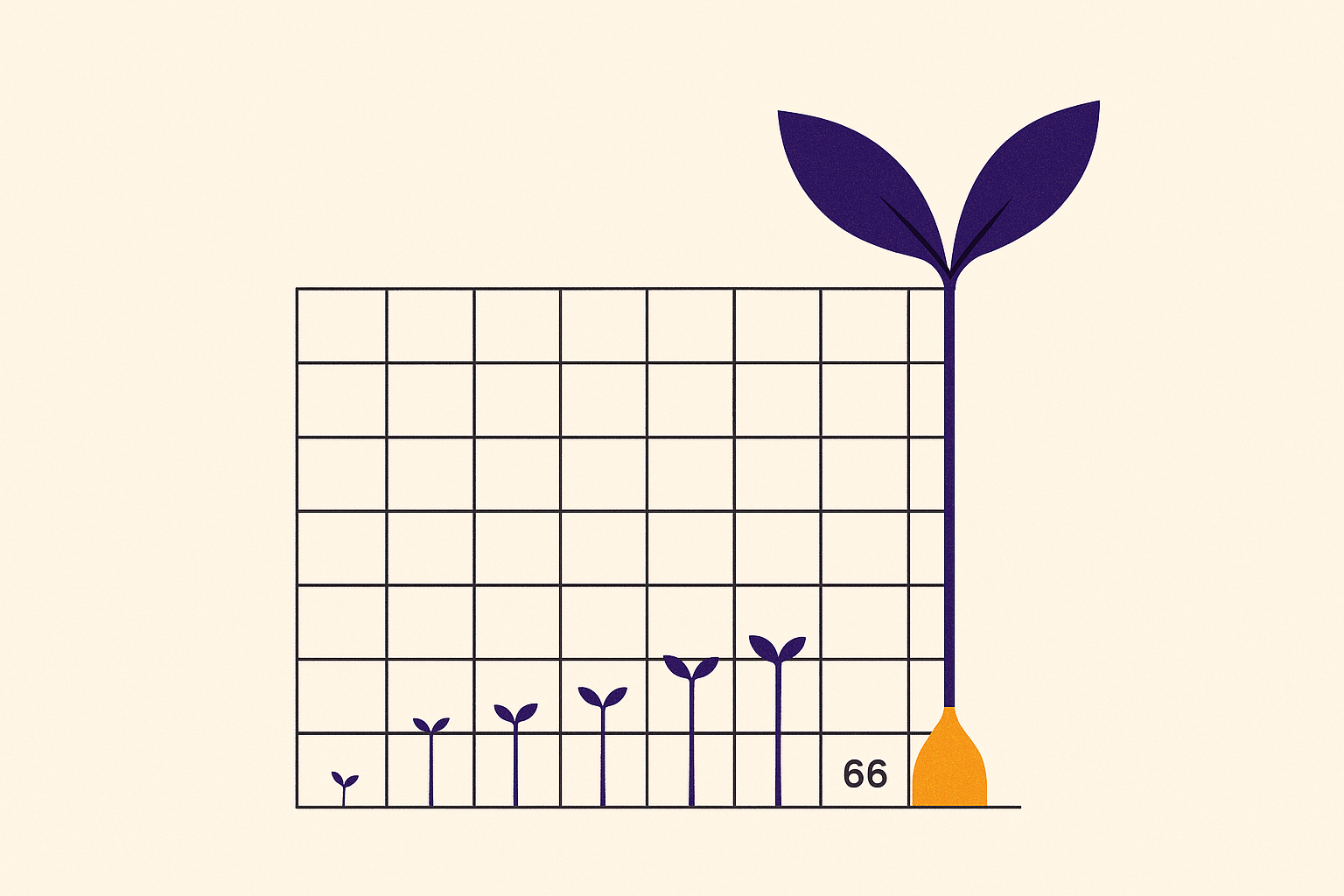
Deliberate-practice research has long shown that skill acquisition is a function of repetition over time, not intensity over a weekend. The specific figure of 66 days comes from habit-formation research suggesting that, on average, a new behavior becomes automatic — requiring less conscious decision-making — somewhere around that threshold. The range varies by behavior and individual. The core finding does not: automaticity requires sustained daily repetition, not periodic immersion.
This has a direct consequence for how you should think about developing presence. A two-day leadership workshop delivers information and perhaps a jolt of motivation. What it cannot deliver is the repetition required for new behaviors to settle into the nervous system. You leave inspired. Three weeks later, you are back to your defaults — not because you lacked commitment, but because defaults are habits, and habits yield only to other habits.
The Micro-Practice Advantage
The phrase "executive presence" can feel monolithic — as though it is one large thing you either possess or you don't. It is more useful, and more accurate, to break it into discrete, scorable behaviors. Each one is small enough to practice in a single conversation, a single email, a single meeting.
None of these require a retreat. Each requires roughly five minutes of deliberate attention, applied consistently.
The power is in the compounding. A professional who improves each dimension by one percent per week barely notices the change in the moment. After 66 days, the cumulative gap between that person and their earlier self is significant — and visible to others before it is visible to them.
- High motivation on day one
- Conceptual understanding of presence
- No repetition loop to create automaticity
- Defaults reassert within weeks
- Learning lives in memory, not behavior
- Lower intensity, sustainable over 66 days
- Behavioral change at the response level
- Repetition builds automaticity
- New defaults replace old ones
- Learning lives in the body, not just the mind
Building the Daily Repetition Loop
The obstacle to daily practice is rarely motivation. It is design. People intend to practice; they do not build the trigger that makes practice happen without a decision.
Habit research consistently shows that new behaviors attach most reliably to existing ones. The practical implication:
- Attach your practice to a meeting you already attend. Before your weekly one-on-one, spend 90 seconds identifying which dimension you are going to practice.
- Score yourself immediately afterward. Not harshly — honestly. Did you lead with the answer? Did you own the outcome or qualify it away? Brief self-assessment closes the feedback loop that makes repetition useful rather than merely habitual.
- Pick one dimension per week. Trying to improve all six simultaneously is how you improve none of them. Narrow focus accelerates change.
The goal is not a perfect performance. The goal is a slightly more deliberate one, repeated enough times that deliberate becomes automatic.
Defaults are habits. And habits yield only to other habits — built one repetition at a time.
Sixty-six days is neither a magic number nor a guarantee. It is an approximation of how long the behavioral science suggests it takes for an intentional act to stop feeling intentional. What it is not is a long time.
Two months of focused daily practice is available to anyone with a calendar and a willingness to treat presence as a skill rather than a gift. That reframe — from trait to habit, from personality to practice — is where lasting change actually begins.